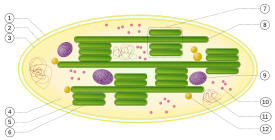
1. outer membrane
2. intermembrane space
3. inner membrane (1+2+3: envelope)
4. stroma (aqueous fluid)
5. thylakoid lumen (inside of thylakoid)
6. thylakoid membrane
7. granum (stack of thylakoids)
8. thylakoid (lamella)
9. starch
10. ribosome
11. plastidial DNA
12. plastoglobule (drop of lipids)
The proteins that gather light for photosynthesis are embedded within cell membranes. The simplest way these are arranged is in photosynthetic bacteria, where these proteins are held within the plasma membrane.[13] However, this membrane may be tightly-folded into cylindrical sheets called thylakoids,[14] or bunched up into round vesicles called intracytoplasmic membranes.[15] These structures can fill most of the interior of a cell, giving the membrane a very large surface area and therefore increasing the amount of light that the bacteria can absorb.[14]
In plants and algae, photosynthesis takes place in organelles called chloroplasts. A typical plant cell contains about 10 to 100 chloroplasts. The chloroplast is enclosed by a membrane. This membrane is composed of a phospholipid inner membrane, a phospholipid outer membrane, and an intermembrane space between them. Within the membrane is an aqueous fluid called the stroma. The stroma contains stacks (grana) of thylakoids, which are the site of photosynthesis. The thylakoids are flattened disks, bounded by a membrane with a lumen or thylakoid space within it. The site of photosynthesis is the thylakoid membrane, which contains integral and peripheral membrane protein complexes, including the pigments that absorb light energy, which form the photosystems.
Plants absorb light primarily using the pigment chlorophyll, which is the reason that most plants have a green color. Besides chlorophyll, plants also use pigments such as carotenes and xanthophylls.[16] Algae also use chlorophyll, but various other pigments are present as phycocyanin, carotenes, and xanthophylls in green algae, phycoerythrin in red algae (rhodophytes) and fucoxanthin in brown algae and diatoms resulting in a wide variety of colors.
These pigments are embedded in plants and algae in special antenna-proteins. In such proteins all the pigments are ordered to work well together. Such a protein is also called a light-harvesting complex.
Although all cells in the green parts of a plant have chloroplasts, most of the energy is captured in the leaves. The cells in the interior tissues of a leaf, called the mesophyll, can contain between 450,000 and 800,000 chloroplasts for every square millimeter of leaf. The surface of the leaf is uniformly coated with a water-resistant waxy cuticle that protects the leaf from excessive evaporation of water and decreases the absorption of ultraviolet or blue light to reduce heating. The transparent epidermis layer allows light to pass through to the palisade mesophyll cells where most of the photosynthesis takes place.


No comments:
Post a Comment